
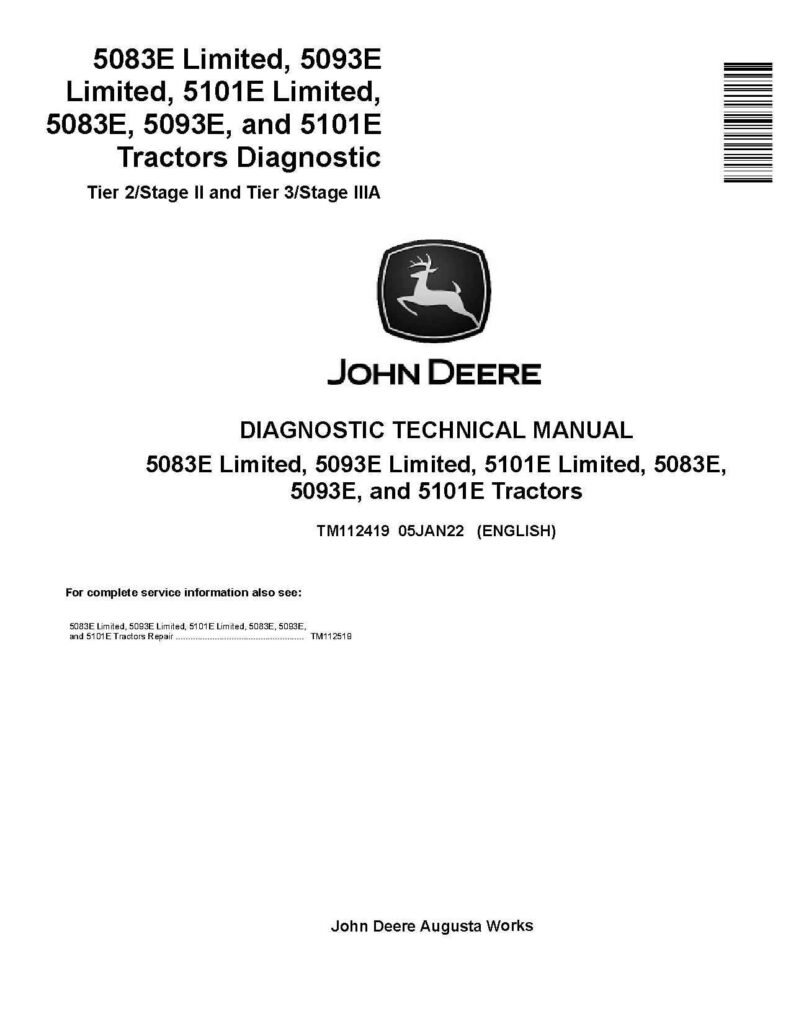
John Deere 5083e 5093e Service Repair Diagnostic Manual
- Manual Included:
- Repair Diagnostic Manual: 1397 Pages (TM112419)
- Specifications:
- Brand: John Deere
- Model: 5083E Limited, 5093E Limited, 5101E Limited, 5083E, 5093E, 2101E (Tire 2/Stage II and
Tire 3/Stage IIIA) - Type: Tractors
- Manuals: Diagnostic Technical and Operator’s Manual
- Publication Numbers: TM112419
- Language: English
- Format: PDF
Repair Technical Manual (TM112519)
John Deere Tractors 5083e And 5093e Technical Manual
Table of Contents
Introduction
- Foreword
General
- Safety
- General Specifications
- General References
Diagnostic Trouble Codes
- CCU Code Diagnostics
- PTR Code Diagnostics
Observable Symptoms
- Engines
- Fuel and Air
- Electrical
- Control Units
- PowrReverser Transmissions
- Drive Systems
- Steering and Brakes
- Hydraulics
- Operator Station
System Diagnosis
- Starting, Charging and Start Aid
- PowrReverser Transmission
- Differential Lock
- MFWD
- Rear PTO
- Steering
- Rear Brakes
- Rear SCV System Diagnosis
- Mid-Mount Control Valve System Diagnosis
- Rear Hitch System Diagnosis
- Air Conditioning
Engines
- General Information
- Tests and Adjustments
- Engine System Theory of Operation
Fuel and Air
- General Information
- Fuel and Air Theory of Operation
Electrical System – Vehicle Electrical Center (VEC)
- Vehicle Electrical Center and Fuse/Relay Block
- Tests and Adjustments
- Theory of Operation
- Functional Schematics
- Connector Information
Electrical System – Load Center ( – Feb 2011)
- Load Center and Fuse/Relay Block (– Feb 2011)
- Tests and Adjustments (– Feb 2011)
- Theory of Operation (– Feb 2011)
- Functional Schematics (– Feb 2011)
- Connector Information (– Feb 2011)
Electrical System – Load Center (Feb 2011 – )
- Load Center and Fuse/Relay Block (Feb 2011 – )
- Tests and Adjustments (Feb 2011 – )
- Theory of Operation (Feb 2011 – )
- Functional Schematics (Feb 2011 – )
- Connector Information (Feb 2011 – )
Control Units
- General References
- Tests and Adjustments
- CCU
- PTR
PowrReverser Transmission
- General Information
- Preliminary and Operational Checks
- Tests and Adjustments
- Theory of Operation
- Schematics and Diagrams
Drive Systems
- General Information
- Preliminary and Operational Checks
- Tests and Adjustments
- Theory of Operation
- Schematics and Diagrams
Steering and Brakes
- General Information
- Preliminary and Operational Checks
- Tests and Adjustments
- Theory of Operation
Hydraulics (– Aug 2011)
- General Information
- Preliminary and Operational Checks
- Tests and Adjustments
- Theory of Operation
Hydraulics (Aug 2011 – )
- General Information
- Preliminary and Operational Checks
- Tests and Adjustments
- Theory of Operation
Operator’s Station
- General Information
- Preliminary and Operational Checks
- Tests and Adjustments
- Theory of Operation
Service Tools
- Dealer‑Fabricated Tools
- Service Tools and Kits
Unleashing Power: John Deere 5083E Horsepower Insights
Unlock the true potential of your farming experience with the John Deere 5083E. Explore its impressive horsepower and tailored features, designed to elevate productivity.
Overview of Horsepower Specifications
When it comes to tractors, horsepower is a critical determinant of performance, efficiency, and capability. The John Deere 5083E is no exception, boasting a robust engine that produces 83 horsepower. This level of power is suitable for a variety of agricultural tasks, whether it be plowing fields, hauling heavy loads, or operating other machinery. The 5083E is equipped with a 4-cylinder turbocharged diesel engine, ensuring that it can handle demanding workloads with ease.
The 83 horsepower engine of the John Deere 5083E is designed to provide a balance between power and fuel efficiency. This ensures that farmers can complete their tasks without excessive fuel consumption, thus optimizing operational costs.
Maintenance Tips for Optimal Performance
To ensure that the John Deere 5083E continues to deliver optimal performance, regular maintenance is essential. One of the most important aspects of maintenance is keeping the engine oil clean and at the proper level. Dirty or low engine oil can lead to increased friction and wear, reducing the engine’s efficiency and potentially causing damage. It is recommended to check the engine oil level before each use and to change the oil and filter according to the manufacturer’s guidelines.
Another crucial maintenance task is to regularly inspect and clean the air filter. The air filter prevents dirt and debris from entering the engine, which can cause damage and reduce performance. A clogged air filter can restrict airflow, leading to decreased power and increased fuel consumption. It is advisable to check the air filter frequently, especially in dusty conditions, and to replace it when necessary. In addition, the fuel filter should also be inspected and replaced as needed to ensure that the engine receives clean fuel.
